
Recognize God’s Care

The children of Israel are trapped. They’ve left the slavery of Egypt and started for a land God promised to give them as their own. Now they are camped on the seashore, with no way to cross the water, and the alarm goes up: the Egyptians are coming after them. They have nowhere to go. They’ll be captured or slaughtered. Panic and despair run through the millions of people.

Moses tells them to be calm. “Just stand still and watch how God will fight for you.” So they watched, and they moved when God said to move. And they saw their pursuers swept away in the sea. The people were filled with awe of what God had done, and they put their faith in Him.

But you know what happens to these people. Time and again, they forget the awe they felt that day. They forget the rescue. They grumble about what God gives them and the plans He has for them. They even decide to seek other gods that might be more to their liking.

That cycle is repeated again and again. God rescues and provides. His people forget and turn away from Him. Until, generations later, God sends a messenger to the people He had chosen and called His own, and He says to them, “You don’t see what I have done for you, what I am doing for you. And you rebel against me and despise me.”

Oh, what a sinful nation they are —
    loaded down with a burden of guilt.
They are evil people,
    corrupt children who have rejected the LORD.
They have despised the Holy One of Israel
    and turned their backs on him.

These were the people who had a unique relationship with God, the ones He had chosen to bless with special favor. He had protected and directed and blessed them. Now they despise Him and rebel.

What a sad story. How did people chosen for great blessings and great destiny wind up an evil people, corrupt, loaded with guilt?

And how can we keep that story from becoming ours? How do we — who also have been chosen, rescued from slavery and given a promise of a rich land — how do we make certain we do not fail in the same way?

Perhaps the key is in the verse just before this. God says, “My people don’t recognize my care for them.”

Is recognizing God’s care for us the key to living in relationship with Him?

Letting our days gallop by and living blind to God’s care opens the door to violating our covenant with Him and turning our backs on the Holy One. Evil. Corrupt. Despising God. Harsh words, but if we fail to recognize what God does for us, the path can easily lead to such a life.

 When I fail to look for God’s care and gifts, when I cannot stand still and see how He fights for me, then I become frantic or gloomy or defeated or frustrated or …. I’m sure you can add a few more words of your own. And when I do not look for, do not see God, then all too easily other gods slip in.

But when we can see how He cares for us, when we see His gifts in every day, then we also see His heart for us. God does still care for and fight for His children. Jesus says the Heavenly Father is far more benevolent with good gifts than any earthly parent, and Paul says God is always working for our good. Do we recognize this in every day?

Once we see our Father’s care, there can be only gratitude for:

      * what God has done to bring us out of slavery and into a free life
      * what He has given us by adopting us as His own children
      * the battles He fights for us
      * the power He plants within each of us
      * His daily gifts to sustain and encourage and delight

Ann Voskamp says that “…gratitude is not only the memories of our heart; gratitude is a memory of God’s heart and to thank is to remember God.”*

Come, let us worship and bow down,
    Let us kneel before the LORD our maker,
    for he is our God.
We are the people he watches over,
    the flock under his care.

Let us worship and bow down.
Amen.

*

Scripture: from Exodus 14; Isaiah 1:3-4 (NLT), Psalm 95:6 (NLT)

*from One Thousand Gifts, by Ann Voskamp
Hiking Lessons on the Cobble

There has been some debate in this Maine vacation house about whether or not this story should even be told; and if it is told, exactly which details should be included and which we would rather omit.

I wanted to hike what seemed a simple little trail. Both of my reasons for pushing my friends to go along with this idea might seem frivolous: I wanted to hike a cobble, and I wanted to set foot on the Appalachian Trail.

Headed to New England, we found a comfortable bed and breakfast in the Berkshire Mountains of western Massachusetts and stopped there on Friday night. Saturday morning, we would hike the trail before continuing our journey to Maine.

Early Saturday morning, I set out from the B&B and flip-flopped up the road just a little ways to the trailhead of the cobble preserve. An information board offered a map of the trail, a circular, two-mile route through field and woods, up over the cobble, along a ridge with promised views of the Tyringham valley, joining with the Appalachian Trail for a short while, and then down again and right back to the parking lot where we started. Looked simple enough to me.

Rain had poured down the day before, and I was a little concerned about the condition of the trail. But along came an elderly man and his dog, down the trail. I saw another figure coming around the bend further down the hill, and that turned out to be his wife. They assured me that the lower portion of the trail, which she had just walked, was wet, but fine.

“But,” he says, eyeing my flip-flops, “if you’re going to walk it, you might want to change shoes.”

Of course.

I was not intending to hike in flip-flops! I was just out for a reconnaissance stroll… of course I would change to more appropriate shoes.

And here is where the details shall be blurred, so that we … I … can save face. So I can say, ‘Yes, we hiked the cobble and we walked on the AT!’ … and you might be impressed.

Three of us took to the hills and woods. The fourth stayed in the village, rambling about on her own photography expedition. We expected to be back by ten, well before the B&B’s eleven o’clock checkout time.

But at three minutes before eleven, there was still no sight of us, and our friend, waiting at the B&B, began to devise an emergency rescue plan …

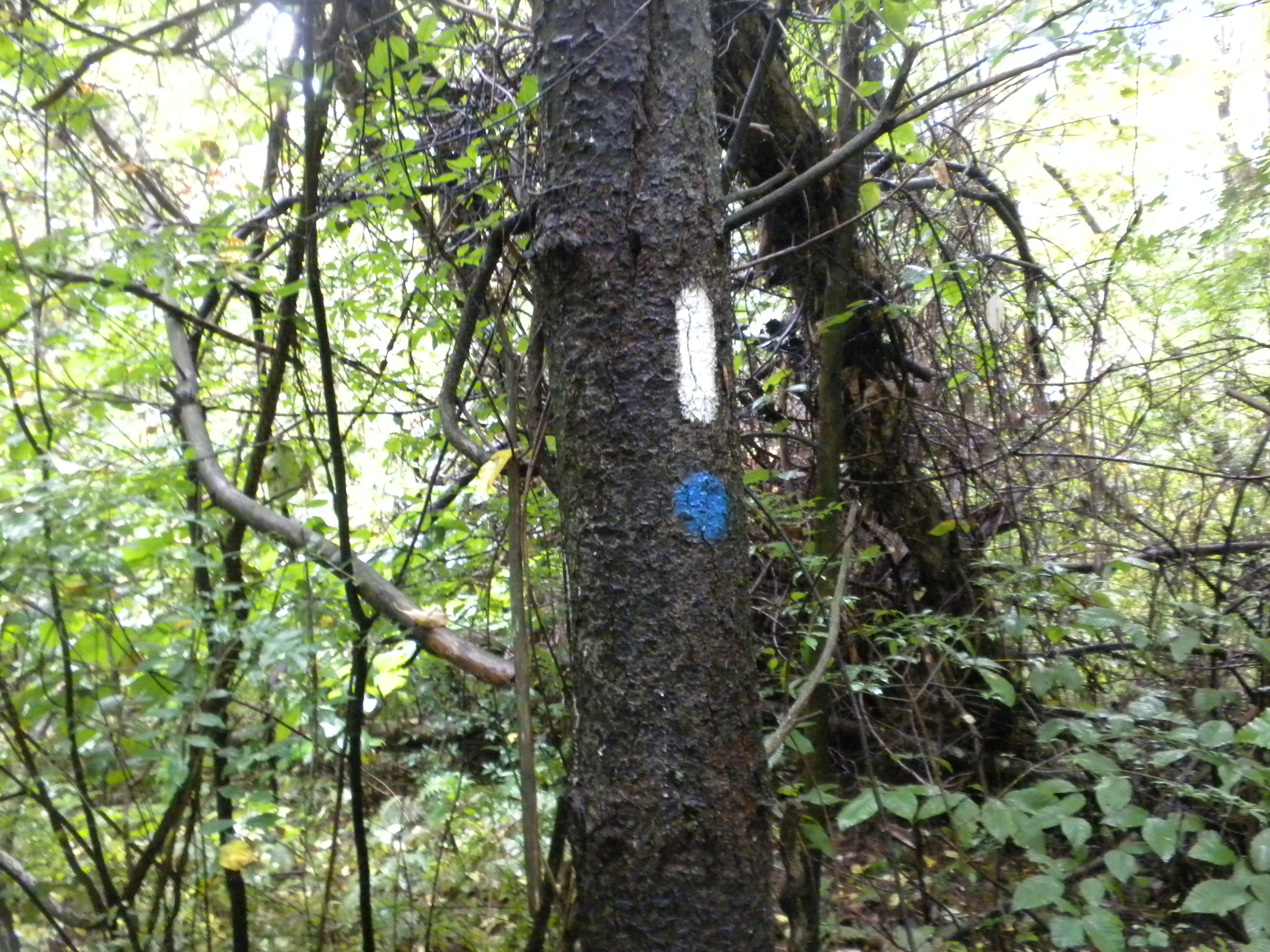
Let’s just say that the morning was not what any of us expected. And probably not what we would have chosen, had we any foreknowledge. And yet, as we huffed and puffed up steep hillsides, straddled with an awkward duck-waddle the trail that had turned into a creek, tried to find firm footing in rivers of mud, and, most important, attempted to decipher the markings meant to keep us on the right trail and going in the right direction — during all of that, I couldn’t help but think of all the spiritual lessons on that short trail.

There were the blazes, beacons meant to keep us going in the right direction. Those blazes were encouraging and beckoning, but sometimes turned discouraging and deceiving.

There were alternate paths that looked good and right … but where would we end up?

There were hard climbs that stretched us further than we wanted to be stretched.

And then there was that lovely, ridge-top rest high above the world.

There was the realization that, once again, we had come unprepared in essential ways. We had made the same mistakes on a vacation hike last year and promised ourselves … never again! Yet here we were, same mistakes. Will we never learn? (No, I’m not giving details.)

There were those folks we met who told us we’d be at trail’s end in just ten minutes. Just a few polite words to weary travelers … how wonderful.

And there was the comforting company of friends, fellow-hikers, struggling just as much as I was, but … hey, we’re in this together … we’ll get through it together.

And besides, we joked, the last thing we wanted was for our local paper back home to carry the headline,

          SEARCH CONTINUES FOR LOCAL WOMEN LOST ON TWO-MILE TRAIL

So we struggled onward. And the very best thing? Coming down the trail at the very last, with the parking lot and familiar landmarks in sight.

That last section of trail was most disagreeable. But we saw home, and then nothing would hold us back.


Forgetting the past and looking forward to what lies ahead, I press on to reach the end of the race and receive the heavenly prize for which God, through Christ Jesus, is calling us.     (Philippians 3:14, NLT)

Blessed are those whose strength is in you [God],
   whose hearts are set on pilgrimage.
They go from strength to strength.
    till each appears before God in Zion.
    (
Psalm 85:5,7, NIV) 

Help me. I don’t know how to pray for you.

You probably have a similar story: I met a coworker on the stairs. “Good morning. How are you?” he asked, without slowing his steps. “Terrible,” I replied because I really was terrible that day and wanted at least one person to know it. “Great,” he said over his shoulder, as he descended the last few steps and started toward his office.

Uh-oh. Is that the kind of exchange you have with other children of God?

A missionary couple led the service one Sunday morning not too long ago. He gave the message and talked about their work of over twenty years in the Congo. But here’s what grabbed me: They get discouraged. They sometimes ask, ‘Why are we doing this? Are we making any difference at all?’

Now that, I get.

I really don’t know much about their daily lives and work in the Congo. But now I can pray for them. Now I do pray for them. Now, whenever I think about that couple, I pray against their discouragement, pray for their encouragement and endurance. Because I understand discouragement and doubts.

Be persistent in your prayers for all believers everywhere.

This encouragement from Ephesians immediately follows Paul’s description of how we can arm ourselves for spiritual battles. Besides taking on the armor ourselves, we’re to pray for all believers who also engage in battle. 

And isn’t that everyone who follows Christ? Everyone who belongs to the kingdom of light?

Paul asks for the prayers of the church in Rome:

Dear brothers and sisters, I urge you in the name of our Lord Jesus Christ to join in my struggle by praying to God for me. Do this because of your love for me, given to you by the Holy Spirit.

What if , instead of a rhetorical HAY (how are you?) to the person you sit beside in church, you say, “I have a question … What is God asking you to do? How’s it going?”

Whoa. What would happen if that were the spontaneous greeting between children of God? We ask about all kinds of other things: How’s the golf game? How’s your wife doing after that surgery? Did the kids all move back to college? Where was the fire in your neighborhood yesterday?

Understand, I’m not in favor of banishing those types of questions. We need to know what’s going on in each other’s lives. As a matter of fact, these subjects that might seem only like chit-chat, superficial HAYs, might be clues to exactly what God is asking of each person at that time. Can we begin to see that? Can we begin to look through the chit-chat and understand what fills the hearts of those we greet?

(And here I will say that there are a few people I meet that say, “How are you doing?” and I know that I can really tell them. They really do want to know. So I tell them the truth. How wonderful!)

But I’m wondering, When do the followers of Christ, who are all on the same mission, who have all been asked to continue Jesus’ ministry — when do we shoot straight and tell each other about the biggest and toughest things in our lives, this business of carrying on God’s mission of reconciling the world to Him? When do I get to tell you about the fierce spiritual warfare that’s been going on in my life; when do you tell me about the new calling God has planted in your heart, that is starting to grow and blossom and scares you to death?

When do we help each other know how to pray and join in our struggle?

Next thought: I’m probably too scared to do this. How about you? Do you feel comfortable asking another child of God, “What is God asking you to do?” Do you have anyone you can ask to join your struggle as you seek to walk the path where God is leading, whether that means forgiving a spouse or changing jobs or telling a coworker what Christ has done in your life or letting go of self in a situation?

Maybe the burden rests on me. Maybe I need to first be telling. We all know that some mornings it is just hard to smile. Then someone smiles at you. You smile! Smiling is easier when someone smiles at you first, and then passing on the smile seems a natural thing to do. In the same way, having someone tell me about her struggle makes it easier for me to talk about my own struggle.

So, maybe, instead of asking, we need to be the ones telling.

I understand that dynamics like this are hard to nurture in a corporate setting. It starts with just a seed, with one person, two. With a love for each other that the Spirit plants within. With a desire to see such a miracle of the Spirit happen in the church. It’s a little — but powerful! — virus that gets passed around … and caught. 

Oh, and hey! This isn’t only for a church congregation. This is for the entire church, Christ’s body, united by one Spirit. The Christian coworker you meet in the coffee room; what has God asked her to do today? Perhaps forgive the person who threw her under the bus in the meeting this morning? If you know that, you can pray for her struggle. The Christian neighbor you meet in the grocery store. What has God asked him to do? What’s his struggle in living Christ’s mission? If you know, you can pray for him when you pass his house, exchange waves in the car.

Missionaries are expected to stand up there and tell the congregation about their struggles to accomplish their mission. They can do it, they are expected to do it; their calling, their lives, are almost on the level of official church business, right? But most of us would never take an opportunity to do that. Many of us won’t even risk doing it in small groups designed for that purpose. But every child of God is called … every one of us is on a mission. Daily, short-term missions. Lifetime missions.

And what if …

What if, when the children of God greet each other, they do not say, “Morning. How are you?” but “What is God asking you to do right now?” Would we not be better able to pray power into each other’s lives if we only knew…?

What if every child of God had someone who would listen with Spirit-tuned heart and hear what prayers are needed? And then, whenever the Spirit prompts, pray power into the other person’s struggle?

What if you and I were willing to be such Spirit-tuned hearts?

What if you had someone, or two or three or four someones, who knew exactly what battles you wage, knew specifically what to pray for in your life, and joined your struggle by praying power into that battle?

What if each of those someones also had three or four Spirit-tuned hearts that knew how to pray for them?

You see where I’m going with this. But there are a few roadblocks to such a dream.

The toughest is that we are not willing to talk about the most important, biggest things in our lives as children of God: the raw, unvarnished truth about our struggles to do what God is asking us to do, today, tomorrow.

I am convicted here. I wonder: Does the enemy use my natural reticence as a weapon to keep from me the power of the prayers of others?

But …

What if …?

Scripture: Ephesians 6:18; Romans 15:30 (both NLT)

Entering Worship

Sunday morning. The bull that escaped last week is still running loose in our neighborhood and I fear it will run through my worship service. I must worship with friends and neighbors, in a church I’ve grown up in — but sometimes I wish they were all strangers. And I wonder if God will say, ‘Your pious meetings disgust me; I am sick of your offerings, and I will not listen to your prayers.’

Such are my thoughts this morning.

I’m intrigued by this renegade bull. How can such an animal evade capture and roam freely in a community so populated, so fenced, so restrictive of independence? We are not the open range. We are small farms and villages, many fences and busy highways. The last update I had from the grapevine is that the animal is still enjoying his interlude of liberty.

But I will go to church and I will see the person who first told me the story. And the farmer whose corn the bull has trampled and eaten. And the man to whom the bull might belong. And I’ll wonder about the latest chapter of the saga. So the bull runs free through my worship service.

And that’s only one simple incident. There are a hundred others. I know far too much about the people I sit with in the pews of our church. And too often, this is a distraction from my worship.

Admit it, sometimes you, too, would better worship if you were in a crowd of strangers. No one to distract you. No thoughts about what has happened to the person in front of you. No bulls running through your worship. No eyes for anyone but the One you came to adore and thank and worship.

My people don’t recognize my care for them.

This is from an opening verse of Isaiah, the LORD speaking about the people of Judah, the people He chose as His own, gave His name, His protection, His blessings.

They have forgotten.

“The children I raised and cared for
    have rebelled against me.
Even an ox knows its owner,
    and a donkey recognizes its master’s care—
but Israel doesn’t know its master.
    My people don’t recognize my care for them.”

Is this the simple antidote for my distraction in worship?

Do I walk into a worship service, or do I enter into worship? What if I could forget about the bull running over the hills just behind the church building and instead think only of how God has loved me?

Do I recognize how God has raised and cared for me?

He has brought me out of the Egypt slavery, snatched me from the kingdom of darkness. Now He holds my hand as I walk in the land of the living, leads me in green pastures. This week of my life has not just been random events. My times are in His hands. He pours gifts into my minutes. He sends daily manna and living water gushes from the Rock.

Do I recognize His care?

When I do, when I think of all this, how can I keep from stretching up my hands in hallelujah, dancing with joy, or throwing myself prostrate before the Holy One?

Oh. Yes. People would talk. Not only are there distracting stories sitting all around me, there are restrictions to my worship. Unspoken and powerful.

Ah, so many problems with corporate worship.*

How do we corral all those thoughts that interfere with focusing on the One we claim to worship? How do we shut out everything else that clamors for time and control in our heads? How do we enter into worship?

Maybe it’s as simple as this: We recognize how the Father has raised and cared for His children. We remember and recount what our Lord has done for us.

I look at my life and see what I might have been without Him. And then I look again and see what I am with Him.

Then nothing can keep me from entering the holy of holies.


Scripture: Isaiah 1:2-3 

****

Sorry, I didn’t get to the part where God says He’s sick of pious meetings. Maybe tomorrow.


* Fear not, pastors. I am not advocating individual isolation within our church body or abandoning our gathering together for worship. I’m also working on a future post about knowing each other better. Because we need to do that, too. Two ideas that seem to conflict: entering into worshiping with all our heart and soul and mind and yet being united with each other … at least for us introverts, that’s a tough combination. Only the Spirit will be able to do that in His church. Another post, another day.

Parable of the Corn Cobs

Daughter and I cook and freeze sweet corn. Boil, blanch, cut. Boil, blanch, cut. Standing side by side at the counter, we slice off the sweet kernels as soon as the ears are cool enough to handle. Chunks of yellow and white fall from knife blade to pan. We toss the stripped cobs into the trash basket behind us.

Twenty-month-old Grandson, barely a head taller than the trash bin, is fascinated by the warmth still coming from the shaved, rough cobs. He reaches for one, but his mother intervenes.

“No, no, honey,” she says. “That’s trash. Here, taste these.” And she hands him a few kernels from her pan; the yellow drops are still hanging together, like a tiny wafer. Tasting and liking, Grandson asks for more. As we work, his mother and I every now and then pass him another bite.

We work, chatting. Then I catch sight of little hands again at the trash bin behind us, hands stretching for the pile of bare cobs, picking one that has a ring of kernels still clinging to the end. Grandson gnaws on it, trying to get a few morsels of sweet gold.

“Honey! That’s trash. I’ll give you more of the good stuff. Just ask me.”

His mother looks up at me and says, “Isn’t that just the way we are with God?”

Yup. We scrounge around, trying so hard to find what we think might be “good” or “the best we can do” according to our own short-sighted and limited perspective. But we may just be eating the leftovers in the trash, when all we have to do is ask God, and He’ll give us something that He knows is so much better. As a matter of fact, He’ll give us what He knows is best for us, something that is often beyond our sight or knowledge now.

You’ve known these verses forever, but try to read them today as though this is the first time Jesus tells you this:

Keep on asking, and you will receive what you ask for. Keep on seeking, and you will find. Keep on knocking, and the door will be opened to you. For everyone who asks, receives. Everyone who seeks, finds. And to everyone who knocks, the door will be opened.

So if you sinful people know how to give good gifts to your children, how much more will your heavenly Father give good gifts to those who ask him.

I have been wondering — in what parts of my life am I just gnawing on corn cobs? Where do I settle for less than the best God can give me? Why don’t I just ask for the really good stuff?

Just ask, God says. Ask, seek, knock. The Father will give His children good things.

Why do we gnaw on corn cobs?


*

Scripture: Matthew 7:7-8,11